Simpler Recycling for micro-businesses: mind the 2027 compliance gap
31st October 2026

In short: from 31 March 2027, workplaces in England with fewer than 10 full-time equivalent employees must separate food waste, dry recyclables and general waste under Simpler Recycling. Yet only 53% of small businesses are aware of the requirements.
Our Managing Director of Waste, Suzanne Mitchison, recently spoke to Facilitate Magazine about the challenges facing smaller businesses as waste regulations evolve.
She said:
“SMEs are often underserved by the commercial waste sector. Most small business owners don’t have procurement teams with the time to scrutinise contracts, check supplier credentials or unpick unexpected charges.
“They need to know what they’re paying, what service they’re getting and that their waste is being handled correctly. That should be straightforward, but too often it isn’t.”
Simpler Recycling requirements came into effect for most workplaces in England on 31st March 2025 – but from 31st March 2027, the same requirement will extend to micro-businesses (those with fewer than 10 full-time equivalent employees). However, Everflow’s research suggests there’s still lots of work to be done to get up to speed, with just 53% of small businesses aware of Simpler Recycling requirements.
It’s clear that a compliance gap exists between what the rules are calling for and what businesses are actually doing in practice. For facilities and operations managers, closing that gap now can help avoid fines and reputational damage once the deadline passes.
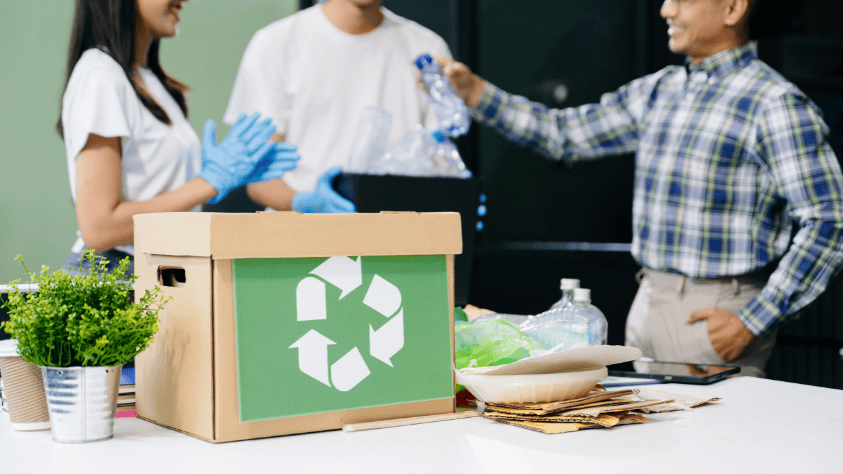
We’ve covered the Simpler Recycling rules before. But it’s worth revisiting the main requirements in relation to separating dry mixed recyclables such as plastic, paper and card, glass recycling and food waste.
Micro-businesses have until 31st March 2027 to comply. However, complying can be harder in practice than it sounds. Smaller businesses often have limited resources to understand the legislation, compare what different waste management companies offer and put the right setup in place.
While businesses in England might have heard of the Simpler Recycling rules, the awareness of compliance and the practicalities of it are seemingly lagging behind. When the rules came into effect in March 2025 for larger organisations, reports suggest that many businesses were unsure of how the rules applied to them, especially those operating across multiple sites or with fluctuating staff numbers.
For smaller businesses, the challenges are often practical. There may be too few bins in the places where waste is produced, unclear signage or employees who aren’t sure which materials belong in which containers. Food waste can end up mixed with general waste, while recyclable materials may become contaminated and more difficult to process.
These issues can also create additional costs, particularly where contaminated recycling attracts extra charges or requires alternative disposal arrangements. A business might have arranged the right collections but still find that its waste segregation system isn’t working as intended. There’s also the question of who is handling that waste.
With limited resources, small businesses may also do fewer checks on whether they’re working with a fully compliant waste management provider. Working with a non-compliant waste management provider, even unknowingly, can result in prosecution and a substantial fine. With 34 million tonnes of waste estimated to be illegally managed in England each year, this is a cause for concern.
As Suzanne highlighted in her interview with Facilitate Magazine, smaller businesses need greater transparency around the services they’re receiving, what they’re paying and how their waste is being handled.
If you’re a micro-business, your next step should be making sure you comply with the Simpler Recycling rules well before 31st March 2027. Review your waste contracts and ensure your commercial waste collection supports separate collection of dry recyclables, food waste and non-recyclable waste.
Make sure your waste segregation system works in practice, not just on paper, and incorporate clear instructions and better signage for the team. While micro-businesses are exempt from the Simpler Recycling rules until 31 March 2027, don’t assume the legislation only affects larger organisations. From that date, these rules will apply to every workplace in England, and getting in touch with us today will help with compliance and making the transition into the right practices smoother.
Yes. Simpler Recycling has applied to workplaces in England with 10 or more full-time equivalent employees since 31st March 2025. Micro-businesses, meaning those with fewer than 10 full-time equivalent employees, have until 31st March 2027 to comply. From that date, the rules apply to virtually every workplace in England, regardless of size or sector.
Micro-businesses need to separate dry recyclables such as plastic, paper and card, glass recycling, food waste and residual (general) waste. Separate collections must be in place for each of these, regardless of how much waste your business produces.
The Environment Agency can issue a compliance notice where it suspects a business isn’t separating its waste correctly. Ignoring a notice is a criminal offence and could be escalated to court. The Environment Agency has also confirmed that non-compliant businesses will be charged £118 per hour for its regulatory work.

Waste shouldn’t be a headache. At Everflow, no job is too big or too small. We work closely with you to build a flexible waste management service around what your business actually produces. Get a bespoke waste quote using the link below.