
What happens to business waste after it leaves your premises?
18th October 2026

Let’s take a look at what happens to business waste once it leaves your premises and why understanding its journey is important for organisations in the UK.
In short: after collection, business waste goes to a waste transfer station where it is weighed, checked and sorted. Recyclables go on to reprocessors, food waste usually goes to anaerobic digestion, waste that can’t be recycled may be used to generate energy, and landfill is the last resort. Your duty of care means you need to know where it goes.
For most businesses, once waste is out of sight, it’s usually out of mind, too. The bins are emptied, the collection vehicle drives away and it can seem like that’s the end of it. But it’s worth remembering that your legal obligation doesn’t actually end there.
Under Section 34 of the Environmental Protection Act 1990, every business has a duty of care for the waste it produces and must handle it responsibly, which includes knowing where your business waste goes after it leaves the premises.
So, with this in mind, it’s worth taking some time to explore where your business waste actually goes and what its final destination may be.
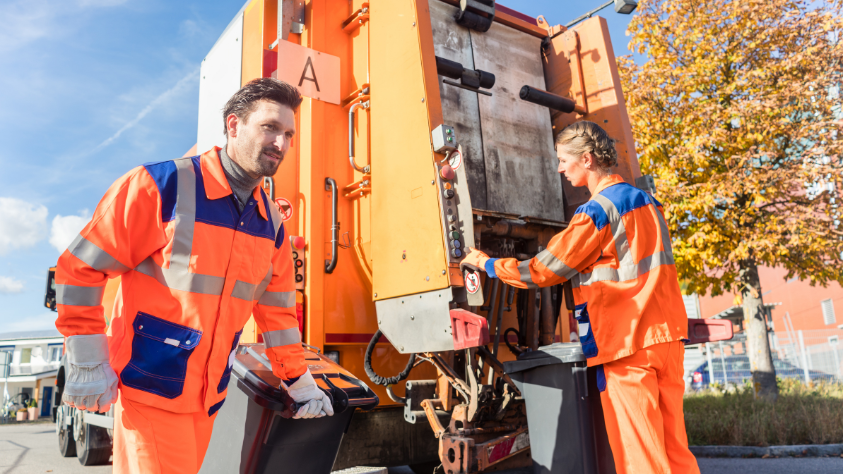
Every load of waste that leaves your premises needs a waste transfer note, showing where this waste is heading. This note also records who produced the waste and who it has been transferred to. This paperwork (paper or electronic copies) must be retained by both the business and the waste management provider for at least two years, in case the Environment Agency or your local council asks to see them to ensure your business is complying.
Speaking of your waste management provider – it is your responsibility to ensure that your waste carrier is registered with the Environment Agency, as overlooking that could lead to fines and legal action.
Since 31st March 2025, workplaces in England with 10 or more full-time equivalent employees have had to separate their waste as per the Simpler Recycling regulations. More specifically, this means separating dry recycling such as plastic, paper, card, glass and metal, as well as food waste. Micro-businesses (fewer than 10 full-time equivalent employees) have until 31st March 2027 to comply with the same regulations.
This means that long before collection happens, your waste should already be separated and smaller businesses can benefit from complying with the regulations prior to the March deadline.
Once your waste leaves your business premises, it is taken into a waste transfer station where it is weighed, screened, checked for contamination and sorted according to what it is, how recyclable it is, its size and how hazardous it may be. The aim during this part of the journey is to recycle as much as possible and reduce contributions to landfill. Anything that can’t be recycled but can be used as fuel is often burned in energy recovery plants to generate electricity and heat.
Businesses in England and Wales have a legal responsibility to keep waste to a minimum by preventing, reusing, recycling or recovering waste materials as much as possible. This is called the waste hierarchy.
The first priority is preventing waste from being produced in the first place.
Where that’s not possible, the next steps are preparing materials for reuse, recycling and other forms of recovery, such as recovering energy from waste.
Disposal, including landfill, sits at the bottom of the hierarchy and should generally be considered only when more preferable options aren’t suitable.
For businesses, this means looking beyond how waste is collected and considering whether it could be reduced, reused or recycled before disposal becomes necessary.
Unlike general waste, food waste takes a different path once it leaves your business premises. Once collected, commercial food waste is often taken to an anaerobic digestion plant rather than landfill, where microorganisms break down the organic matter to produce biogas for energy. The leftover digestate can then be used as a fertiliser in farming.
By keeping food waste separate from general waste, it is possible to make this treatment process much easier and dramatically reduce the amount of organic material that goes to landfill where it decomposes to produce methane – a particularly potent greenhouse gas.
The journey of your business waste does not stop once the collection takes place. As a business in the UK, you have a duty to ensure that your waste is separated before collection and that whoever collects your waste is a registered waste carrier.
Here at Everflow, compliant, simple and flexible commercial waste collection is what we’re known for, including commercial glass collection. Get in touch with our team for peace of mind that your waste is handled correctly, long after it leaves your premises.
Your business and your waste management provider must each keep waste transfer notes, on paper or electronically, for at least two years. The Environment Agency or your local council can ask to see them to check you’re complying, so keep them somewhere easy to find.
You can check if your waste carrier is registered by searching the Environment Agency Public Register for Waste Carriers, Brokers and Dealers.
Commercial food waste is often taken to an anaerobic digestion plant rather than landfill. There, microorganisms break down the organic matter to produce biogas for energy. The leftover digestate can then be used as a fertiliser in farming.

Waste shouldn’t be a headache. At Everflow, no job is too big or too small. We work closely with you to build a flexible waste management service around what your business actually produces. Get a bespoke waste quote using the link below.


